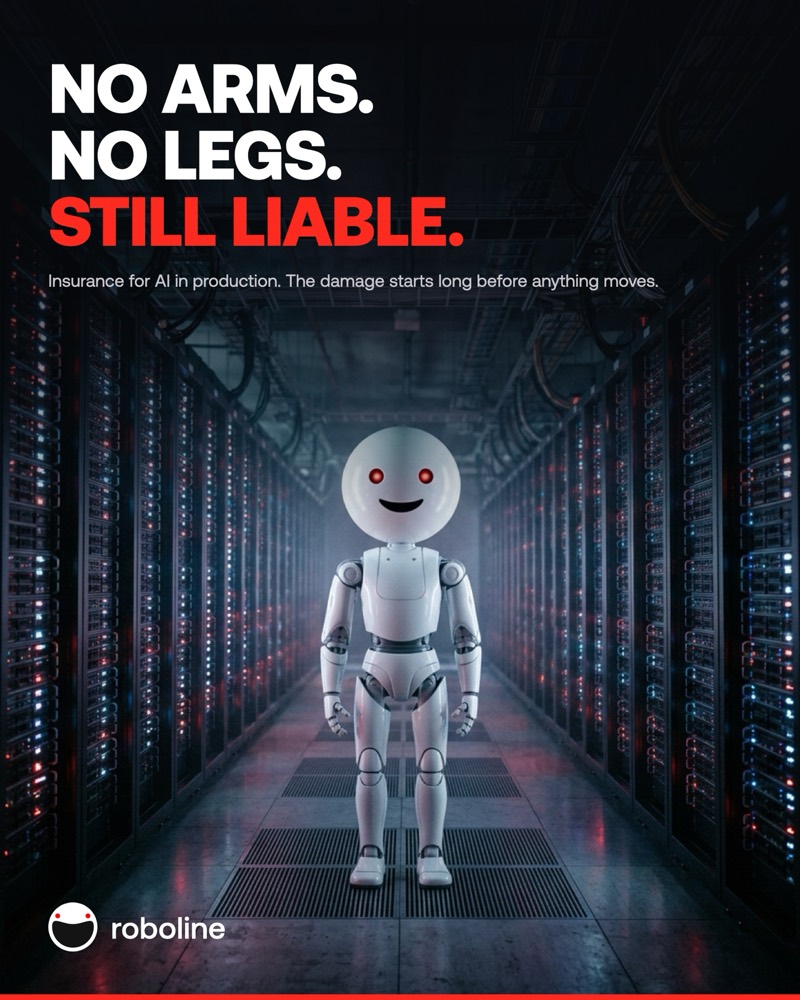
When your model gives the wrong answer — or your agent takes the wrong action — someone pays. Roboline underwrites deployed AI: liability, interruption, and regulatory defense, priced from your real usage.
Cover for AI without a body — models, agents, and automated decisions built into production systems.
RL-01 → RL-06Cover for intelligence with mass — humanoids, fleets, and the machines entering the physical world.
Series RL-10 ↗General liability and cyber policies were written for software that waits to be told what to do. Production AI decides, speaks, and transacts on its own — and courts, customers, and regulators are already treating its output as yours.
A support model invents a refund policy, quotes a price that doesn't exist, or gives advice a professional would be sued for. Courts have already held companies to what their bots said.
A procurement agent orders 10,000 units instead of 100. A trading assistant rebalances at the worst moment. Autonomous action means autonomous loss — at machine speed.
Generated copy, code, or imagery lands close enough to a protected work to draw a claim. Provenance disputes over training data are following right behind.
A crafted input walks your model into exfiltrating customer records or executing an action it never should have. The attack surface is the conversation itself.
Your product runs on someone else's model. An outage, a deprecation, or a silent quality regression takes your revenue down with it — with no SLA that makes you whole.
The EU AI Act, state AI statutes, and sector regulators are converging on deployed AI. An inquiry is expensive even when you did everything right.
A human workforce makes uncorrelated mistakes at human speed, and that is the only reason conventional liability insurance works. Autonomy removes all four brakes at once — variance, speed, scope, and hesitation — and what is left is not a higher-frequency version of the old risk. It is a different risk with a different shape, and it is why standard forms are adding AI exclusions rather than pricing it.
Loss accumulates at machine rate while detection runs at human rate. The exposure is not the error — it is the window between the error and somebody noticing.
Shared code fails identically everywhere it runs. Independence — the assumption under every actuarial table ever written — simply does not hold.
Some liability is multiplied by law rather than by harm. Where damages are fixed per act, an automated system converts a configuration error directly into arithmetic.
The determinism that makes a model defensible in one case is what makes it certifiable as a class in a hundred thousand. Uniform conduct is the element plaintiffs usually struggle to prove — and you log it for them.
Inference volume tells you how busy a system is, not how much damage it can do. For anything that acts without a human confirming the specific action, the underwriting question is narrower and answerable: how much loss can this produce before somebody stops it?
Every term is measurable from telemetry you already emit, and every term is something engineering can move. Halving detection latency halves the number. A spend cap truncates it outright. This is the one figure we will not accept an estimate for, because it is the difference between a claim and an insolvency.
The same agent with a per-hour spend ceiling and anomaly alerting at fifteen minutes carries an MUL near $360,000. Same model, same volume, same accuracy — a fourteenfold difference in what it can cost you, and therefore in what it costs to insure.
Above an MUL threshold, rate limits and spend ceilings stop being a discount and become a condition of cover — the way sprinklers are in fire and immobilisers are in motor. You warrant they are on; we verify from telemetry.
Exposure is capped per foundation-model dependency across the whole book, and the cap is disclosed. An insurer silently accumulating the same correlated risk as its insureds is not a counterparty — it is a second point of failure.
When one upstream cause hits every insured at once, adjudication collapses under its own volume. Systemic cover triggers on the observable event — a withdrawn model version, a provider outage, a fleet-wide rollback — and pays from the record.
In January 2026 ISO published generative-AI exclusion endorsements for commercial general liability — CG 40 47, CG 40 48 and CG 35 08 — and more than sixty US insurance groups have filed around adopting them. Where one is attached at your renewal, the policy you have paid for no longer responds to bodily injury, property damage or advertising injury “arising out of” generative AI — including where the AI was a vendor's, or only a contributing cause. RL-07 is the cover for exactly that hole, and nothing else.
That sentence is the product. RL-07 follows the form of your underlying GL — same occurrence trigger, same limits, same definitions — and responds to the loss the exclusion removed. There is no new wording to negotiate and nothing for a broker to reconcile against the underlying, because the underlying defines it.
Plus an affirmative grant for the unsettled part. The ISO wording targets generative AI; whether an agentic system or a robot falls inside it is genuinely undecided. RL-07 covers that loss whether or not the exclusion would have applied, so you are not funding the test case.
The closest precedent is the standalone terrorism market that formed after insurers excluded terrorism in 2002: priced as a percentage of the underlying premium, around 7% in the first year and settling to 2.5–3%. AI-excluded loss is a larger share of expected GL loss for a firm that actually uses AI, so the bands run higher and are set by what the system does.
Indicative, subject to the underlying policy's limits and a copy of the scheduled exclusion. Minimum premium applies.
The scheduled exclusion from your renewal — the form number is all we need to define the cover.
Advisory, agentic, or embodied on premises. That sets the band; telemetry can earn it down later.
Follow-form to your GL, so your customer's insurance clause is satisfied without a new programme.
Bind the lines that match your deployment. Every line shares one telemetry integration, one renewal, and one claims desk. Expand a line for what it covers.
Limits: $1M – $10M per occurrence · Retention from $10K
Limits: $500K – $5M per occurrence · Priced by autonomy tier
Limits: $1M – $5M aggregate · Stacks over provider indemnity
Limits: $250K – $2M per event · Parametric triggers available
Limits: $1M – $5M per incident · Coordinates with existing cyber
Limits: $500K – $2M aggregate · Includes pre-claim counsel hours
Limits: follow the underlying GL · Rated 5–22% of the GL premium by AI use
An honest schedule names its edges. These are ours — printed here, not discovered at claim time.
Losses you engineered. Deliberate deployment of a system known to be defective, or the use of AI as a weapon. Insurance covers accidents; it doesn't finance them.
Fines the law forbids us to pay. RL-06 covers penalties only where insurable in the relevant jurisdiction — and says so, line by line, in the schedule.
The bug that was in your tracker at binding. Shipped anyway, it's yours. Disclosed at underwriting, it can usually be endorsed back in — disclosure is cheaper than discovery.
Degradation with nothing to degrade from. RL-04's quality trigger pays against the eval baseline booked in your policy. No baseline, no trigger — we'll help you book one at binding.
Nation-state attacks and acts of war. The standard edge of the private market, here as everywhere.
Existential scenarios. We underwrite accidents, not the end of the world. What we can price — correlated, provider-scale failure — is capped, reinsured, and set out in our vision paper.
Most AI underwriting still runs on static intake — a questionnaire, once a year. Roboline adds the live operational signals you already monitor: volume, autonomy, evals, guardrails. Same risk, far less guesswork priced into your rate.
Drop in the Roboline SDK or grant read-only API access to your observability stack. No telemetry yet? Start with a structured questionnaire and migrate later.
We score volume, autonomy tier, tool access, eval coverage, and guardrails into a risk profile. Better engineering literally lowers your premium.
Pick lines and limits, bind online, and get a certificate of insurance your enterprise customers' procurement teams will accept — in days, not quarters.
File with the trace. Your logs are the claim file, which is why our decision target is five business days — not five months of discovery.
We ask you to connect telemetry, so we owe you specifics about what that means before your team has to chase them. Everything here is on the page rather than behind a sales call.
Most teams are emitting underwriting signal the same day they start. The SDK wraps the calls you already make and reports shape, not content — and you can run it in dry-run first to see exactly what would leave your network.
// wraps your existing call — reports shape, never content
import { roboline } from "@roboline/sdk";
const rl = roboline({
key: process.env.ROBOLINE_KEY,
mode: "dry-run", // print, don't send
region: "us"
});
const result = await rl.action({
line: "RL-02",
scope: "billing.refund.execute",
approval:"human", // or "autonomous"
value: 1840
}, () => refunds.execute(order));
Traditional claims are slow because the evidence is testimony. Yours is a trace. Here is the same procurement-agent loss from Sec. 02, end to end.
Your procurement agent confirms a 100× order with a no-cancellation supplier. A guardrail fires late, the run halts, and an incident opens in your tracker — the same alert you'd get with or without us.
You open a claim from the dashboard and attach the trace bundle: tool-call log, approval state, guardrail events. No narrative forms — the logs are the narrative.
Our desk replays the trace against your RL-02 schedule. Coverage is confirmed in writing, unwind costs are reserved, and counsel engages the supplier — as your problem becomes ours.
The decision target: settlement wired for the unwind cost and liquidation loss. Any recovery from the supplier is our subrogation to chase, invisible to you.
The incident joins your telemetry profile. One incident is weather; a pattern is climate. And the guardrail you shipped after it shows up as a discount at renewal.
Move the controls to see an indicative monthly premium. Bound pricing comes from underwriting your actual telemetry — most quotes land within a day.

The division everyone forgets to insure. A model that never touches anything can still quote a price that does not exist, move money that should not move, and leak a record it should never have read.
Why insurance has gated every previous machine age, how correlated model risk is capped and reinsured, the lines we are drafting next, and the twenty-five-year market case — kept off this page so it stays about your cover.
Tell us what you're running and we'll come back with indicative terms — usually within one business day.
Get a quote Insure a household instead