HouseholdsAIRoboticsStandardRequireRatingMarketModelVisionPitch日本語
Roboline Robotics · Homes and fleets · Pilot underwriting open

Liability, for machines that move.

Humanoids are moving into warehouses and logistics sites faster than anyone has priced them. Specialist robotics cover exists — but humanoid risk still has no standardized rate table. Roboline is building one from robot-hours, interventions, and near-misses.

Priced per robot-hour
Pilot fleets underwriting now · US industrial & logistics
General availability target 2027
Household bundle to follow 2028
Sec. 01 — The risk

Software liability, at 60 kilograms and walking speed.

A chatbot's worst output is words. A humanoid's worst output is force. The moment a model gets actuators, every failure mode gains mass, momentum, and a bystander. General liability, product liability, and commercial auto can each respond to parts of that — but none was drafted for a machine that decides its own next movement, and none of them prices the telemetry that predicts it.

Bodily injury

The arm didn't stop

A handoff misjudged, a torque limit exceeded, a person where the map said shelf. Third-party injury is the defining loss of embodied AI — and the first question every deployer's counsel asks.

Property damage

The payload dropped

A 20-kilogram tote through a glass counter, a pallet clipped at speed, a fall onto a customer's car. Small perception errors become large invoices when they carry weight.

Update failure

Tuesday's model walked differently

A fleet-wide policy update regresses gait or grasping. Yesterday's safe robot is today's incident cluster — and the "defect" was pushed over the air by you.

Teleoperation

The human took over too late

Shared autonomy blurs the liability line: was the loss the model's plan, the operator's intervention, or the handoff between them? Your policy shouldn't need a trial to decide.

ODD violation

It left the map

Every deployment defines an operating domain — aisles, hours, weather, proximity rules. Losses that happen outside it are where traditional carriers deny first and litigate second.

Bricking

The fleet won't boot

A bad firmware push, a revoked model license, a vendor sunset. A hundred robots become a hundred statues — with lease payments and contractual SLAs still running.

Sec. 02 — The statutory floor

The states already decided. The limit is $100,000.

Sidewalk delivery robots are the one class of autonomous machine that has already been through a legislature — more than thirty states now have personal-delivery-device laws. The answer, repeatedly, was to treat the machine as a pedestrian and attach an insurance minimum. That minimum is the most useful number in this business, because of how small it is.

Compulsory

United States

Virginia · Florida · Louisiana · and others
Legal status
Rights and duties of a pedestrian
Speed cap
10 mph on sidewalks (VA)
Liability insurance
$100,000 GL where required
Basis of the limit
Combined operations — not per device

Virginia's statute is representative. A personal delivery device on a sidewalk “shall have all the rights and responsibilities applicable to a pedestrian”, may not exceed 10 mph, and its operator must carry “general liability coverage of at least $100,000 for damages arising from the combined operations of personal delivery devices”. Japan reached the same pedestrian analogy in 2023 and drew the opposite conclusion, placing these machines outside compulsory motor insurance entirely.

Read the American limit closely. It is not $100,000 per device, or per incident, or per year. It is $100,000 for the combined operations of the fleet — one number covering every unit an operator runs in that state.

What $100,000 buys, once
Fractured tibia, surgical fixation$35,000 – $60,000
Follow-up imaging, physio, hardware removal$8,000 – $20,000
Lost earnings, twelve weeks$15,000 – $40,000
Defence costs, contested liability$25,000+
One pedestrian. One robot. One afternoon.Limit exhausted
Illustrative ranges for a single moderate injury, not a claims study. The point is not the precision — it is that the statutory minimum is inside the range of one ordinary accident, and it is shared across the whole fleet. The second claimant that year is arguing with an operator, not an insurer.
A compliance floor is not a coverage decision.
It is the number a legislature could pass.

This is what makes delivery robots the most useful precedent in embodied AI. Nobody argued much about whether machines in public space should carry cover — legislature after legislature answered yes, quickly and without controversy, and settled on a placeholder number because nobody had loss data to set a real one. That is the pattern every heavier class of machine will follow: the requirement arrives first, the limit gets serious after the first cluster of claims.

A humanoid on a shop floor is forty times the mass of a delivery robot and works within arm's reach of people. When that class is compelled — and the sidewalk precedent says it will be — the limit will not start at $100,000. We are building the loss data that gets used to set it.

Sources — Va. Code § 46.2-908.1:1; Fla. Stat. § 316.2071; 日本損害保険協会. Not every state with a personal-delivery-device law attaches an insurance requirement; among those that do, $100,000 general liability is the common figure. Statutes summarised as at August 2026 and vary by state — confirm the current text and your own obligations with counsel. Cost ranges are illustrative.
Sec. 03 — Series RL-10 schedule

The embodied lines.

Series RL-10 extends the same policy architecture as our AI lines — clause codes, telemetry underwriting, one claims desk — to machines with mass. Lines marked pilot are binding coverage for design partners today.

RL-10 Humanoid General LiabilityPilot — binding now Third-party bodily injury and property damage from an autonomous humanoid. +

Covers

  • Third-party bodily injury, including bystanders and co-workers where permitted
  • Third-party property damage from movement, manipulation, or dropped payloads
  • Defense from first notice, inside limits
  • Contractual liability to sites hosting your deployment

Limits: $1M – $25M per occurrence · Priced per robot-hour by ODD class

Example claim

The aisle handoff A warehouse humanoid transfers a tote as a picker reaches in; a wrist actuator clips their forearm. RL-10 covers the injury claim — and the incident's IMU and vision logs are the claim file, not a deposition fight.
RL-11 Machine Physical DamagePilot — binding now First-party cover for the unit itself — a six-figure asset on two legs. +

Covers

  • Accidental damage: falls, collisions, drops, crush events
  • Theft and vandalism, on site and in transit
  • Actuator, sensor, and battery failure outside warranty
  • Agreed-value settlement — no depreciation haggling on a young asset class

Limits: agreed value per unit · Fleet aggregates available

Example claim

The staircase A patrol unit misclassifies a landing edge and falls two flights. RL-11 pays agreed value less retention within days of the trace review — the robot's own logs establish the loss event.
RL-12 Update & Bricking When the software push is the peril: regressions, rollbacks, dead fleets. +

Covers

  • Fleet losses caused by a firmware or model update regression
  • Bricking: units unrecoverable after a failed push or revoked license
  • Rollback, re-certification, and re-deployment costs
  • Business interruption while the fleet is grounded

Limits: $500K – $10M per event · Requires staged-rollout practices

Example claim

The Tuesday push A grasping-policy update ships fleet-wide and drop rates spike 40× before rollback. RL-12 covers the damaged goods, the grounded shifts, and the re-certification of the corrected policy.
RL-13 Teleoperation Cover for the human in the loop — and the handoff between human and model. +

Covers

  • Losses during teleoperated control, including remote operator error
  • Handoff-gap incidents between autonomous and manual modes
  • Latency- and disconnection-induced loss events
  • Operator-liability claims against your teleop staff or vendor

Limits: $1M – $10M per occurrence · No autonomy-vs-operator coverage dispute: one line pays

Example claim

The frozen frame A teleop link drops for 900ms during a manual override in a stockroom; the unit continues its last commanded motion into shelving. RL-13 pays without litigating whether the model or the operator "had" the robot.
RL-14 Fleet Deployer Program One master policy for operators running humanoids across many sites. +

Covers

  • All RL-10 through RL-13 lines under one master fleet policy
  • Per-site certificates for landlords, clients, and municipalities
  • Usage-based premium that follows robot-hours as the fleet scales
  • Fleet-level safety telemetry benchmarking, shared back with you

Structure: master + certificates · Premium follows deployed hours, not headcount

Example claim

The new site A logistics operator adds a fourth facility mid-term. The site is endorsed from its telemetry profile in days — no re-broking, no coverage gap between go-live and paperwork.
RL-15 OEM Product Liability For the companies building the robots — defect claims across a shipped fleet. +

Covers

  • Product liability for hardware and embedded-model defects
  • Recall and field-retrofit costs, including OTA remediation campaigns
  • Failure-to-warn and instruction-defect claims
  • Vendor's-interest coordination with your deployers' RL-10 policies

Limits: $5M – $50M aggregate · Underwritten from your test and field telemetry

Example claim

The batch of wrists A supplier's encoder batch drifts out of spec across 400 shipped units. RL-15 funds the OTA mitigation, the field retrofit, and the defect claims — coordinated so your customers' policies don't subrogate against you.
RL-20 Household BundleLive — humanoid endorsement 2027 One consumer policy for every AI-powered machine in the home. +

Covers

  • Liability for autonomous actions of any covered household device
  • Device protection: malfunction, update failure, end-of-support
  • Household data and privacy across every connected agent
  • One premium, one deductible — the home humanoid added by endorsement

Distribution: direct + OEM partnerships · Priced per household, not per device

Why it's a bundle

The drawer of warranties A home in 2028 runs a humanoid, a vacuum, a kitchen arm, and a security system — each with a warranty that excludes "software behavior." RL-20 replaces the drawer with one policy that covers exactly that.
Sec. 04 — Performance & asset lines

The lines that grow as your fleet gets better.

Liability cover is priced on failure, so a fleet that improves pays less for it every year — as it should. These lines work the other way. A machine that is more reliable holds its value longer, meets its uptime commitments more often, and costs less to keep running. We would rather be paid for that than for your accidents.

Pilot · OEM channel
RL-19 · Service Contracts

The warranty that sees it coming

Multi-year parts-and-labour cover attached at the point of sale. Because we read force anomalies, duty cycles, and thermal drift, we can flag an actuator or battery before it fails — turning a claim into a scheduled maintenance ticket. Priced as a share of hardware value; administered by us, sold by the OEM.

In design · 2027
RL-21 · Residual Value

What the fleet is worth at lease end

Lessors will not write humanoid leases without a residual model, and no residual model exists — so fleets get bought instead of leased, or not at all. We guarantee the residual so the lease gets written. Residual value insurance is established in auto, aviation, and equipment finance; only the asset class is new.

In design · 2028
RL-25 · Machine Workforce

Where the safety budget lands

The employer's line for a mixed human-and-machine workforce. When a shift moves from people to robots, the risk it carried does not disappear — injury exposure to the remaining human crew, to visitors, and to third parties re-attaches to the machines. RL-25 is written to receive that budget rather than watch it shrink.

In design · 2027
RL-22 · Availability

Backstop for the uptime you promised

Robotics-as-a-service means someone commits to an availability figure and pays penalties for missing it. We reinsure that commitment, measured continuously from the same telemetry that prices the rest of the fleet. Your SLA becomes a covered exposure rather than an uncapped promise.

Casualty — priced on failure

RL-10 · RL-11 · RL-12 · RL-13 · RL-14 · RL-15

Rate per robot-hour falls as the fleet improves
Performance & asset — priced on capability

RL-19 · RL-21 · RL-22 · RL-25

Value rises as the fleet improves
Sec. 05 — Underwriting a body

Robots are the most insurable machines ever built.

A humanoid logs every joint torque, every plan, every intervention, every near-miss — a black box richer than anything in aviation. Legacy carriers can't read it. Our underwriting engine was built for it.

Signals we underwrite from — read-only, metadata-level, no camera frames leave your system:

  • INTERVENTION RATEHow often a human takes over. Our leading hypothesis for loss frequency — and the first thing our pilot data is built to confirm or kill.
  • NEAR-MISS EVENTSSafety-stop and proximity triggers. Losses that almost happened price the ones that will.
  • ODD ADHERENCETime spent inside the agreed operating domain. Out-of-domain hours price differently — not deniably.
  • FORCE ANOMALIESTorque and contact-force outliers. Early signal of hardware drift and grasp regressions.
  • UPDATE CADENCEStaged rollouts vs. fleet-wide pushes. Deployment discipline directly discounts RL-12.
  • HOURS IN SERVICEThe exposure base. Premium accrues per robot-hour — an idle fleet costs almost nothing to insure.
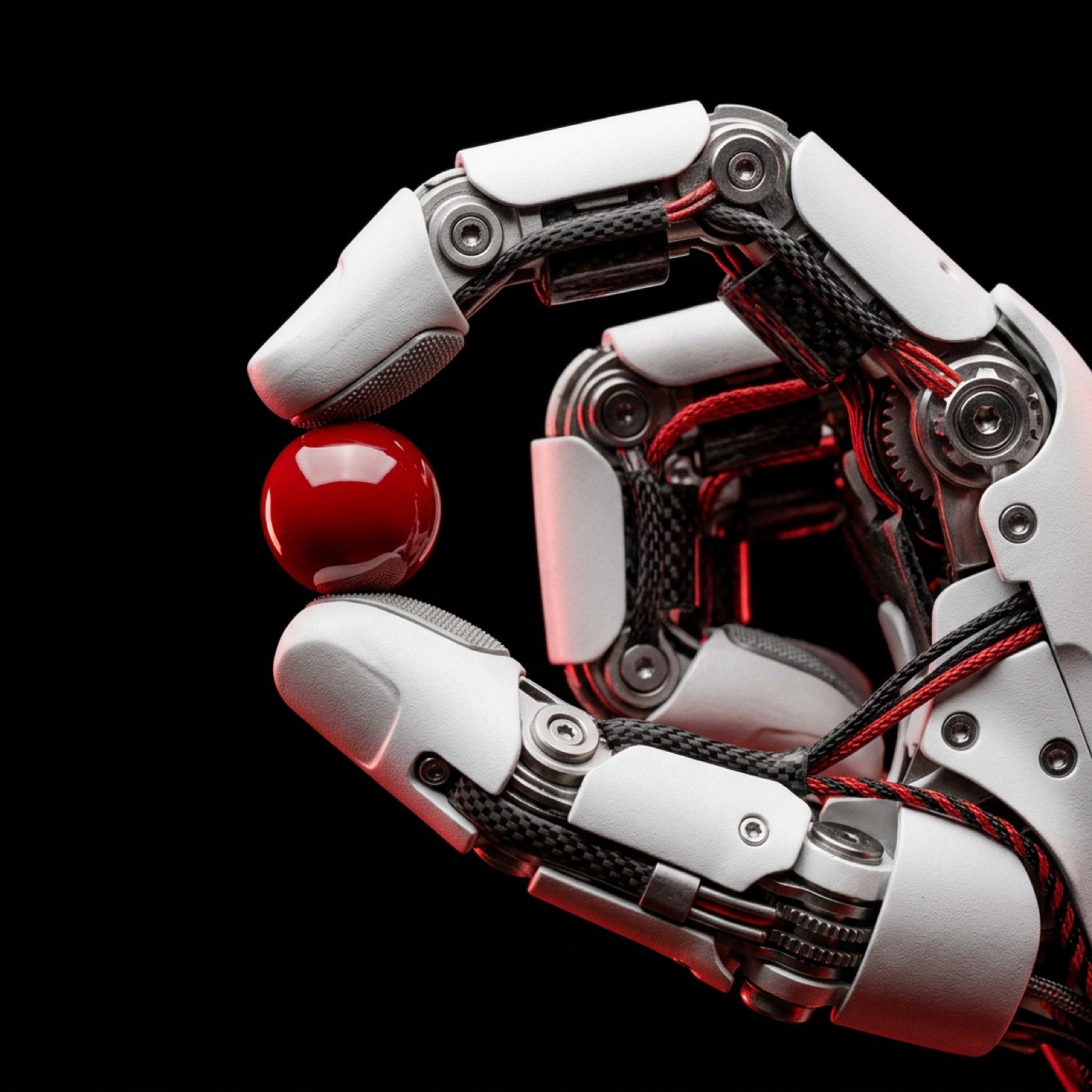
Macro of a precision robotic hand holding a small red sphere
Fig. 03 — Precision under load
Your safety case is your rate.

Every deployer tells us their robot is safe. Telemetry lets them prove it — and be priced on the proof. Fleets that improve their intervention rate quarter over quarter watch their premium follow it down. That's the market working the way it never could on paper questionnaires.

Sec. 06 — Correlated risk

One update. Ten thousand bodies.

A humanoid fleet is a monoculture: the same policy weights, the same firmware, the same blind spot — replicated in every unit. Accident math built on independent events breaks here. Ours doesn't, because it was never built on it.

Rollout discipline, priced

Canary or pay for the herd

RL-12 terms are materially cheaper for staged rollouts with automatic rollback than for fleet-wide pushes. Deployment discipline isn't a best practice we recommend — it's a rating variable we measure.

Platform aggregation

We cap our own book

Exposure is capped per OEM platform and per foundation-model dependency, so a single regression can't take down insurer and insured together. The cap is disclosed to fleet clients — concentration risk you can see is concentration risk you can plan around.

Grounding cover

Parametric, per robot-day

If a defect grounds your fleet — by regulator order, OEM stop-use, or your own safety call — parametric grounding cover pays per robot-day from the order record itself. Aviation has AOG cover; robotics now does too.

Sec. 07 — Indicative fleet pricing

Premium per robot-hour. Like the machines earn it.

Move the controls for an indicative monthly figure across RL-10 + RL-11. Pilot-program pricing is bespoke and underwritten from your actual telemetry.

Indicative premium · RL-10 + RL-11
$8,600–$13,000
per month · ≈ $2.98/robot-hour · $5M per-occurrence limit
Indicative only. Pilot pricing is underwritten per deployment from ODD class, telemetry history, site conditions, and chosen limits and retentions. Agreed unit value for RL-11 assumed at $120K per unit.
Sec. 08 — Beyond humanoids

Everything that moves will need a line.

Humanoids are the beachhead, not the boundary. The same telemetry engine underwrites anything with actuators and a log — and the next embodied lines are already drafted.

In design · 2027
RL-16 · Mobile & Delivery

Sidewalks, aisles, and airspace

Delivery robots, warehouse AMRs, and drone fleets — priced per mile and per flight-hour, with municipal liability certificates cities actually accept. The kerbside is a jurisdiction; we write for it.

In design · 2027
RL-17 · Retrofit Autonomy

Old iron, new brain

Autonomy kits on legacy machines — forklifts, tractors, excavators — create a liability seam between the machine's maker and the kit's. RL-17 writes across the seam so the farmer isn't the one litigating it.

Live · humanoid endorsement 2027
RL-18 · Public-Space Operations

The permit's other half

Cities will permit robots in public space the way they permit scaffolding: show the certificate. RL-18 is that certificate — public liability written for machines among crowds, with the telemetry conditions that keep them welcome.

Sec. 09 — Who it's for

Four seats at the table. One policy language.

Every humanoid deployment has an OEM, a deployer, an operator, and a site. Roboline writes each seat — with clause codes that interlock instead of subrogating against each other.

OEMs

Ship with cover attached

Embed insurance in the sale or lease. A humanoid that arrives pre-insured closes enterprise deals faster than one that arrives with a risk memo.

Lines: RL-15 · RL-12
Deployers

Pass procurement

The COI your customer's risk team actually asks for — humanoid-specific liability with limits that match the site, not a stretched GL policy.

Lines: RL-10 · RL-11 · RL-14
Operators

Cover the loop

Teleop vendors and supervision teams carry their own defined slice — so a handoff incident has an answer before it has a lawsuit.

Lines: RL-13
Households

One policy, every robot

When the humanoid comes home, the household bundle is waiting: liability, device protection, and privacy in a single consumer policy.

Lines: RL-20 · 2028
Sec. 10 — The build

From pilot fleets to the household policy.

Now — 2026

Pilot underwriting

RL-10 and RL-11 binding for design-partner fleets in industrial and logistics settings. Every pilot feeds the actuarial base: robot-hours, interventions, near-misses, losses. Partners get preferential terms locked through GA.

2027

Series RL-10 general availability

The full embodied schedule — RL-10 through RL-15 — opens to the market: fleet master policies, per-site certificates, OEM programs, and a humanoid rate card published openly rather than quoted case by case.

2027

RL-20 Household — humanoid endorsement

The consumer bundle ships with OEM distribution partners: one policy covering the home humanoid and every AI appliance around it — liability, device protection, and household data cover under one premium.

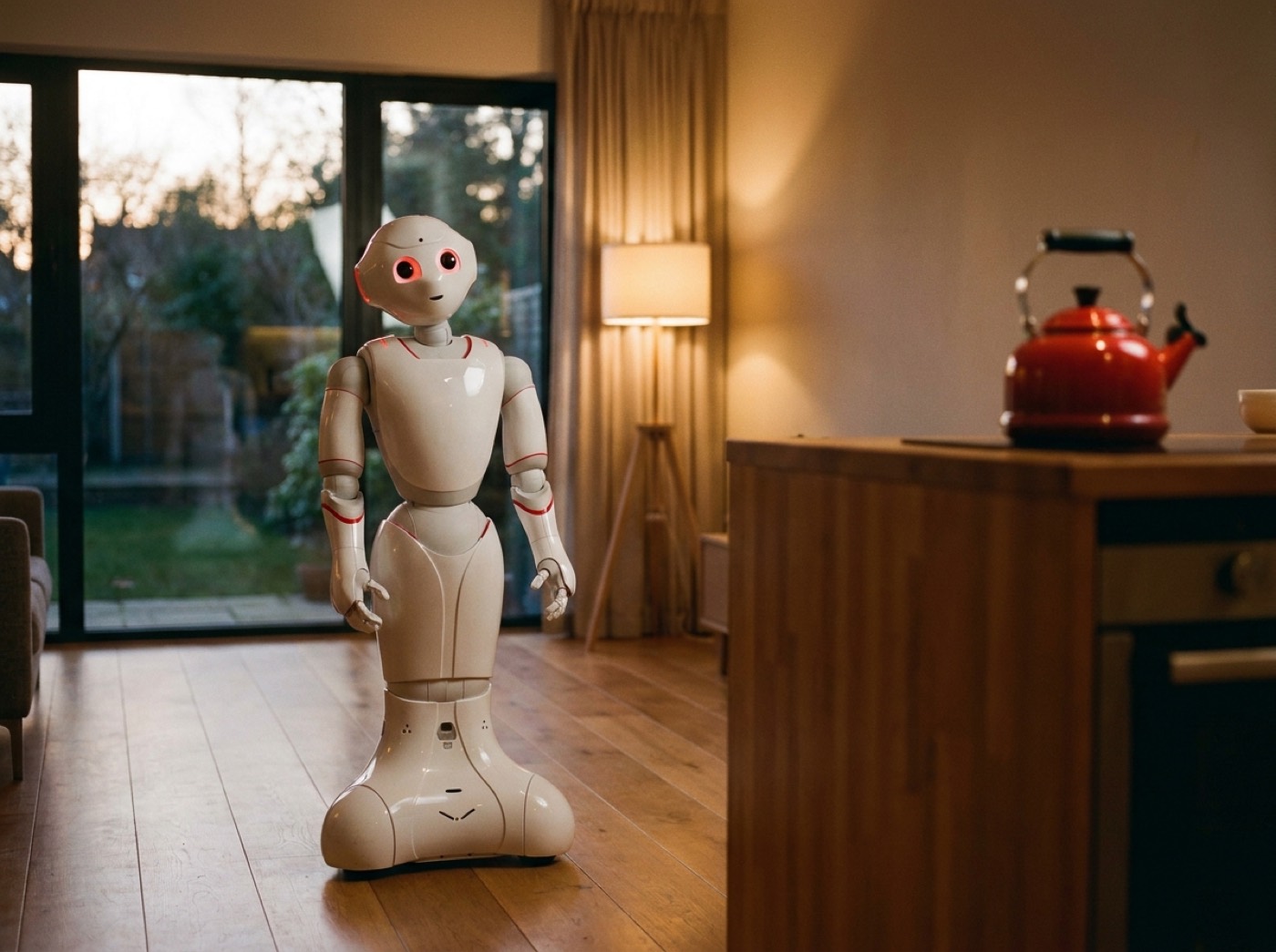
Domestic humanoid robot in a warm living room at dusk
Sec. 11 — Questions

Asked, answered.

Can you actually bind humanoid coverage today? +
Yes — for pilot-program partners. RL-10 (general liability) and RL-11 (machine physical damage) bind now for qualifying industrial and logistics deployments, issued through our carrier partners on a surplus-lines basis. The rest of the series reaches general availability in 2027. If you're deploying sooner than that, that's exactly who the pilot is for.
Why won't our existing GL or product liability policy handle this? +
Ask your carrier to confirm — in writing — how an autonomous humanoid's movements are treated. Some will respond to parts of it; many will exclude or reserve rights. GL forms assume human acts, product liability assumes a static defect, and commercial auto assumes a vehicle, so a machine that plans its own motion tends to fall in the seams between all three. Specialist robotics cover does exist — what Roboline adds is a form written around humanoid telemetry and rated on robot-hours rather than headcount.
What telemetry do you need, and who sees it? +
Metadata only: hours in service, intervention events, safety-stop triggers, ODD adherence, force anomalies, and update history. No camera frames, no maps, no proprietary policy weights. It flows read-only, is used for rating and claims, and is never shared — except benchmarks we hand back to you against the anonymized fleet pool.
How is a claim handled when the cause is ambiguous — model, hardware, or human? +
That ambiguity is the reason the series is structured as interlocking lines under one desk. Your policy pays the loss first from the triggered line; allocation between RL-10, RL-13, and an OEM's RL-15 happens behind the settlement, between us and our carrier partners — not in front of your injured claimant or your customer.
We're an OEM — can insurance ship embedded with the robot? +
That's the RL-15 program design: your units ship with an insurance attachment your buyers activate at deployment, priced from your platform's aggregate telemetry. It shortens your enterprise sales cycle and gives us fleet-scale data — the reason we can price this market when no one else can. Talk to us about a distribution partnership.
How does this relate to Roboline's Intelligence Liability lines? +
Roboline is two-fold: the Intelligence Liability division (RL-01 through RL-06) covers AI built into systems without a body — models, agents, automated decisions — and the Robotics division (Series RL-10) covers what happens when intelligence gets one. Same underwriting engine, same claims desk. Deployments that run both — an agentic brain in a physical fleet — get one integrated policy rather than two carriers pointing at each other.
Every body needs cover.
The campaign

Every body needs cover.

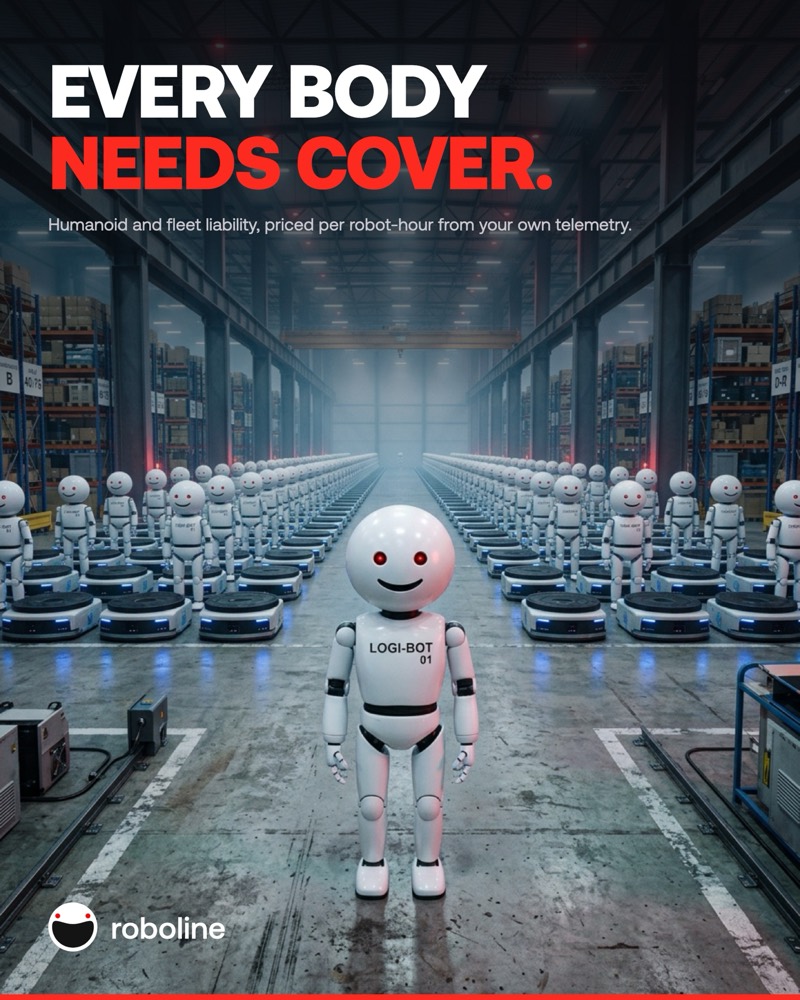
A fleet is not one risk repeated — it is one risk correlated. The same policy weights, the same blind spot, standing in ranks. That is why we rate per robot-hour and cap our own exposure per platform.

The robots are ready.
Now their paperwork is too.

Deploying humanoids in the next 18 months? Join the pilot: preferential terms locked through GA, binding cover now, and a seat in defining how humanoid risk gets rated.

Start an application    OEM partnerships