HouseholdsAIRobotics StandardRequireRatingMarketModelVisionPitch 日本語
robolineVision

Machines are about to become the largest class of insured risk on earth.

Every previous machine age needed an underwriter before it could scale. This one is arriving without one. Roboline is building the rating layer for autonomous risk — and the twenty-five-year case for why that layer, not the policies on top of it, is where the value settles.

Roboline · Vision & market thesis · 2026
01 — The shift

Work is moving from bodies that tire to bodies that log.

The important fact about a humanoid is not that it can lift a box. It is that lifting the box produces a record — force, path, intervention, near-miss — at a fidelity no human workplace has ever generated. Autonomy does not just create a new risk. It creates the first risk class that measures itself.

~620M
Deployed units, base case 2051
Advanced mobile and humanoid robots in commercial and domestic use. For scale, roughly the number of cars on the road in 1990.
~$920B
Annual risk & service spend, 2051
Insurance premium, service contracts, and financial guarantees attached to autonomous machines. Comparable to global motor insurance today.
$9–27B
The rating layer's share
At the 1–3% of served premium that rating and data infrastructure historically captures. That is the defensible floor — the scale case on slide 05 is a different and much larger number.
02 — Precedent

No machine age has ever scaled before someone agreed to carry its downside.

This is the most reliable pattern in industrial history, and it is not a metaphor. In each case the insurance arrived first, and the deployment followed it.

1688

Marine

Underwriting at Lloyd's made distant voyages financeable. Without hull and cargo cover there is no merchant fleet, and without a fleet there is no world trade.

1866

Steam

Boilers exploded routinely until an insurer tied cover to inspection. Factories electrified around the certificate, not around the boiler.

1898

Motor

The first automobile policy predates the highway system and the driver's licence. The premium came first; the century of the car followed.

2026

Autonomy

Humanoids are entering warehouses with no rate table, no exposure unit, and no agreed vocabulary for what went wrong. The gap is the opportunity.

Each transition also produced an institution that outlived the specific technology — not the carrier that wrote the first policy, but the body that defined the classifications everyone priced from. That is the seat we are going for.

03 — The market

Built bottom-up, from units and spend per unit.

Not a top-down slice of a trillion-dollar TAM. Deployed machines multiplied by what it costs each year to insure, service, and finance them — with per-unit spend falling throughout, because that is what safety improvement does.

Annual autonomous risk & service spend

USD billions · base case
Robotics — fleets & humanoids Intelligence — AI without a body Households
0 250 500 750 1000 2026 2030 2035 2040 2045 2051 $919B total $713B robotics

How to read it: per-unit spend falls from roughly $2,800 to $1,150 per robot-year across the period as machines get safer and volumes scale, while unit counts rise faster. The market grows despite the price of risk falling — which is the whole argument on the next slide.

Show the model
YearUnits (M)$/unit-yrRoboticsIntelligenceHouseholdTotal ($B)
20301.42,8003.92.00.66.5
2035182,10037.812858
2040951,6001523431217
20452901,3003775872507
20516201,15071382124919
04 — Scale check

Is $920B a serious number, or a spreadsheet artefact?

The honest way to test a projection is to hold it against markets that already exist. Autonomous risk in 2051 lands in the same band as motor insurance today — which is what you would expect if machines take on a meaningful share of physical work.

Against today's major lines

USD billions · annual premium
200 400 600 800 1000 Autonomous 2051 $919B — projected Motor, global ~$900B Property, global ~$620B US workers' comp ~$60B Cyber, global ~$15B

The useful comparison is cyber. Twenty years ago cyber insurance was a rounding error that most carriers declined to write because the risk was unmeasurable and correlated. It is now a major line with its own rating science. Autonomous risk is at the point cyber was in roughly 2005 — and unlike cyber, it arrives already instrumented.

05 — Scale

Three engines produce a giant. We are building for all three.

Insurance has exactly three ways to get enormous, and the companies that dominate it run all three at once. None of them is "write good policies" — that is table stakes. Every product decision on this site is chosen to feed one of these.

Engine 01

Compulsion

Motor insurance is the largest line on earth because it is required, not because driving is uniquely dangerous. Compulsion converts a market from persuasion to participation.

Our move — the slow half Machines working in public space will be permitted the way scaffolding is — show the certificate. We publish the standard, sit in the working groups, and make ARC the vocabulary that requirement gets written in.
Our move — the half available today Statutory compulsion needs a legislature. Contractual compulsion needs one enterprise buyer, and it is how commercial liability lines have always actually spread: a customer writes the requirement into the MSA and every vendor in the supply chain goes and buys cover, usually without reading the policy. So we wrote the clause and published it free at roboline.com/require — carrier-neutral, satisfied by anyone's paper. We are not waiting to be the beneficiary of a requirement. We are trying to author it.
Engine 02

Migration

We do not need a new pool. There is an enormous existing one — the risk load carried on human physical work — and it moves onto machines as machines do the work. Being where a pool lands beats creating one.

Our move Write the employer's machine-workforce line (RL-25) so that when a warehouse shifts a shift's worth of labour to robots, the risk budget moves to us rather than simply shrinking.
Engine 03

Float

The quiet engine. Premium collected years before claims are paid is investable capital, and the largest insurers are capital allocators wearing a risk-transfer costume. Long-tail products are worth more than their margin suggests.

Our move Service contracts collect four years up front. Residual value collects for years and pays at term end. We picked those lines for learning rate — they happen to be the two best float generators available.
06 — The migrating pool

The safety budget of physical work does not disappear. It changes owner.

Every economy already spends heavily to carry the risk of humans doing physical labour — workers' compensation, employer liability, safety programmes. As machines take that work, the spend does not vanish with the worker. It re-attaches to the machine, and it lands on whoever is positioned to write it.

Where the physical-work risk budget sits

Share of the pool · illustrative
Carried on human labour Carried on machines
0% 25% 50% 75% 2026 2035 2040 2051 Human labour Machines ~35%

Why this matters more than a new market: a migrating pool comes with established buying behaviour, existing budget lines, and regulators who already accept that this risk must be carried by someone. New markets need persuading; migrating pools only need capturing.

Two independent models, one answer
Bottom-up (slide 03)
~$920B

620M deployed units × $1,150 average annual risk and service spend per unit.

≈
Top-down (this slide)
~$500–900B

Global physical-work risk budget of roughly $500B, of which ~35% migrates by 2051, multiplied by the additional exposures a machine carries that a worker does not — damage to the asset itself, obsolescence, update failure, data.

These were built independently and land in the same band. That convergence is the strongest evidence in this document — a single model is a guess, two models agreeing from different directions is a finding.

07 — Capital

You cannot become large while renting someone else's balance sheet.

This is the part most insurtechs never do, and it is why most of them top out. A managing agent earns a fee on premium it places. A carrier earns the underwriting profit and holds the float. The gap between those two businesses is roughly an order of magnitude in enterprise value — and crossing it is a deliberate, capital-intensive decision rather than something that happens by growing.

Stage 01 · Now

Managing agent

We design, underwrite, and adjudicate; carrier partners issue the paper and hold the risk. Fast, capital-light, and the right way to start.

Earns a fee · holds no float
→
Stage 02

Retain a share

Take a quota share of our own book once loss experience is credible. Skin in the game, and the first real underwriting profit.

Earns fee + margin · holds some float
→
Stage 03

Own paper

A licensed carrier. Full economics, direct regulatory standing, and — the point — the reserves become ours to invest.

Earns full margin · holds the float
→
Stage 04

Allocator

Float invested with discipline, and deployed into the machines we insure — financing fleets whose residual value we already guarantee.

Earns margin + investment return

Stage 04 is where this stops being an insurance company and becomes the financial infrastructure of the machine economy. We would insure the robot, guarantee its uptime, guarantee its residual — and then lend against it, using float generated by the policies. Captive finance arms have made several industrial giants larger than their manufacturing parents, and no one is positioned to do it for autonomous machines yet.

08 — The tension

The pool for accidents shrinks. The pool for trust grows.

Insurance prices failure, and autonomy's promise is fewer failures. Anyone building a company that profits when robots crash is building on a base that success erodes. We designed around that from the start.

Share of autonomous spend by line family

% of total · base case
Casualty — priced on failure Performance, service & finance — priced on capability
0% 25% 50% 75% 26% 74% 78% 22% 2026 2035 2040 2051

The crossover lands around 2035. Liability premium per robot-hour falls throughout, and total casualty premium still grows in absolute terms — it simply grows far slower than service contracts, availability guarantees, and residual value cover, which are paid for because the machine is dependable.

Shrinks per unit as robots improve
Casualty

Liability, machine damage, grounding. Every incumbent will chase these to the floor, and they should — this is the commoditising half.

Grows as robots improve
Performance & finance

Service contracts, availability backstops, residual value guarantees, certification. A better machine is worth more, holds uptime, and is more financeable.

09 — Architecture

We are not trying to become an insurance company.

Insurance decomposes into layers that can be owned separately. The visible one is products. The durable one is the layer underneath: the loss database and the models that turn a signal into a price. It compounds with every claim and cannot be bought.

L5

Distribution

OEM checkout, lessors, RaaS platforms, brokers.

Rent
L4

Products

The policies and contracts themselves. Expect churn — they are copyable.

Hold
L3

Capacity

Whose balance sheet absorbs the loss. Carrier partners and reinsurance.

Cede
L2

Rating — loss data and the models on it

What a signal is worth in expected loss. Grows more valuable as more entrants need it, including competitors.

Own
L1

Sensing

Telemetry ingestion. Real work now; a commodity once the interface standardises.

Hold

The comparable is not a carrier — it is a rating bureau: the institutions that own the classifications, forms, and loss data that every participant prices from. They take no underwriting risk, are extraordinarily hard to displace, and earn from the whole market rather than their slice of it.

We write policies because writing policies is how the database gets built. In the early years, premium is not the product — it is the cost of acquiring the only asset here that compounds.

10 — The wedge

We published the vocabulary before anyone asked us to.

Whoever's classifications regulators eventually cite becomes infrastructure. So we released ARC — an open standard for autonomy tiers, operating domains, safety signals, incident severity, and the definition of a robot-hour — under CC BY, free for competitors to rate from.

The framework is open. The loss coefficients are not. Anyone can adopt the vocabulary; only claims experience tells you what each signal costs, and that has to be earned rather than published. Giving away the map while keeping the survey is the whole strategy in one move.

ARC
Open classification standard
Five definitions the whole industry lacks: tiers, ODD, signals, severity, exposure. Published at v0.1 while it is still wrong in places.
Telemetry
Underwriting from operations
Metadata only — never prompts, records, or camera frames. Every policy instrumented from day one as a binding condition.
Both halves
Bodyless and embodied
The only book covering an agent and the fleet it drives on one integration. Nobody else is positioned across the seam.
11 — The arc

Three eras, and what we are in each.

Era I2026–2032
Instrument

An underwriter that is secretly a data programme

High-frequency lines through OEM distribution — service contracts and availability backstops, which produce events weekly rather than the liability claims that arrive yearly. Liability is sold because customers demand it, not because it teaches us anything.

Measured by: instrumented unit-years, not written premium
Era II2032–2040
Standardise

The reference everyone prices against

ARC matures from a draft into the vocabulary regulators cite and OEM safety cases are written in. Financial lines open as fleets age and resale markets appear: residual guarantees become priceable, and the largest manufacturers start needing their captives administered — by us.

Measured by: citations from parties who are not customers
Era III2040–2051
Infrastructure

A risk book, and the layer the market runs on

The underwriting book is by then a respectable specialty business and no longer the interesting part. The interesting part is that carriers entering the class, captives, lessors modelling residuals, and regulators setting thresholds all price from our data — a business that grows precisely as casualty premium commoditises.

Measured by: share of revenue not derived from bearing risk
12 — What would make us wrong

The four ways this thesis fails.

A projection with no failure conditions is a mood board. These are the ones we watch, with the signal that would show up first — reviewed quarterly, and this page revised when one of them fires.

Risk 01 · Adoption

Humanoids stay niche

Deployment plateaus in the low millions. Never enough exposure to build credible experience, and the fixed cost of being an insurer never amortises. Tell: pilot-to-production conversion below a third by 2028.

Risk 02 · Vertical integration

OEMs capture the whole stack

Makers bundle insurance, finance, and service into the machine price and retain the margin. We get compressed into a data vendor. Tell: the first OEM who wants to white-label rather than distribute.

Risk 03 · Incumbents

A reinsurer moves first

Someone with far more capital and existing OEM relationships publishes a competing rating framework. They need only be adequate and already trusted. Tell: that publication. Being second in a standards race is losing.

Risk 04 · Legislation

Liability is simplified away

Strict manufacturer liability with statutory caps and a compensation pool would make the risk cheap and uniform, removing the need for sophisticated rating. Tell: serious no-fault proposals in any major jurisdiction.

Risks 02 and 03 are the live ones and they pull in opposite directions: moving quietly loses the standards race, while moving loudly tells incumbents exactly where to aim. Our resolution is to be conspicuous with the framework and quiet about the coefficients — publish what invites adoption, keep what took claims to learn.

13 — What we are building

The rating layer for a market that does not have one yet.

Every previous machine age produced one institution that outlasted the technology: not the first carrier, but the one that defined how the risk was measured. That seat is open for autonomy, and it will not be open for long.

Now

Binding pilot cover for humanoid fleets, and the first OEM service-contract programme — chosen because they generate the most events per dollar of premium.

Building

ARC v1.0 with manufacturer and operator input, availability backstops for RaaS operators, and residual value cover as resale markets emerge.

Looking for

Design-partner fleets, an OEM distribution partner, carrier capacity for the embodied lines, and reviewers willing to tell us where ARC is wrong.

Talk to us
Appendix — The brand

A category nobody has heard of needs a voice people remember.

Twenty-nine posters and three films, built on the same face. Insurance advertising is the least-read writing in commerce, so ours is built on one idea — the calm, cheerful face standing next to a machine that just did something strange — because the job is to make an unfamiliar risk feel handleable rather than frightening.
The film — "One line through everything" · 30s
One unbroken red line, followed from a house at dusk, through a home full of working machines, out into a fleet of thousands, down a data centre aisle, and finally into the pages of a policy. The line is the product — it is the same underwriting running through every place intelligence ends up.
Also — households, 5 seconds
The bot does nothing. Everything else in the house is working around it. Six machines, one deductible, in one shot.
FilmOne line through everything · 30s
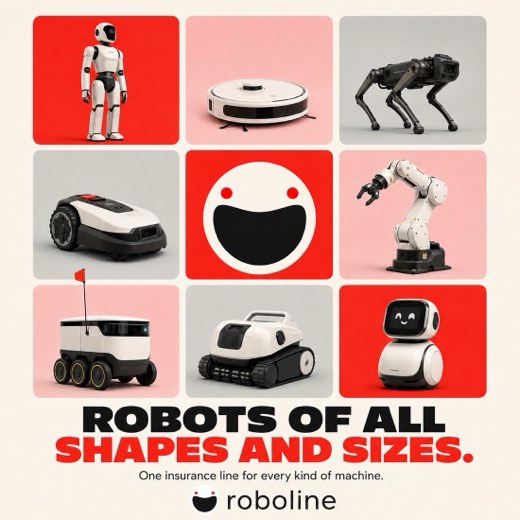
Robots of all shapes and sizes
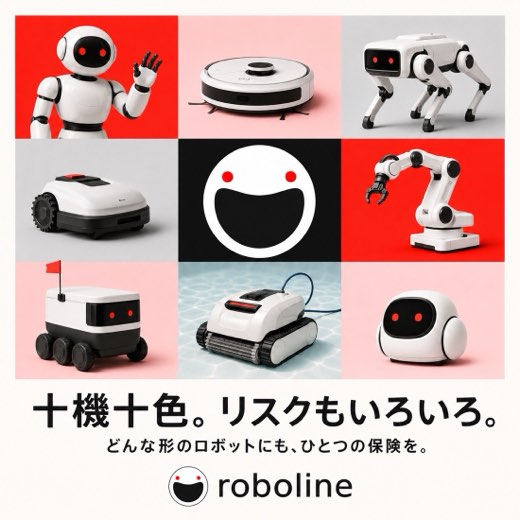
十機十色。リスクもいろいろ。
十機十色。リスクもいろいろ。
Intelligence on tap needs protection
知能が流れる時代に、安心を。
知能が流れる時代に、安心を。
ロボットだって、転ぶ。
ロボットだって、転ぶ。
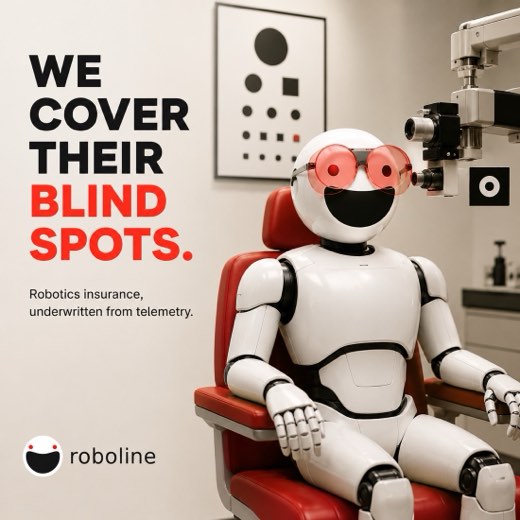
We cover their blind spots
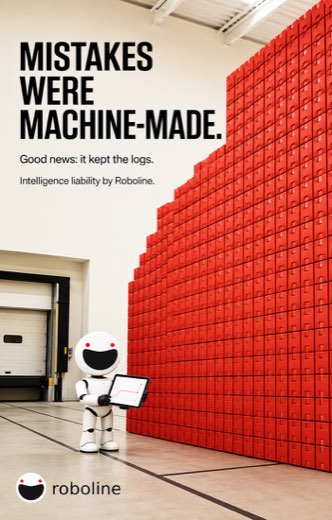
Mistakes were machine-made
Accidents are human. Liability isn't.
The cloud has feet now
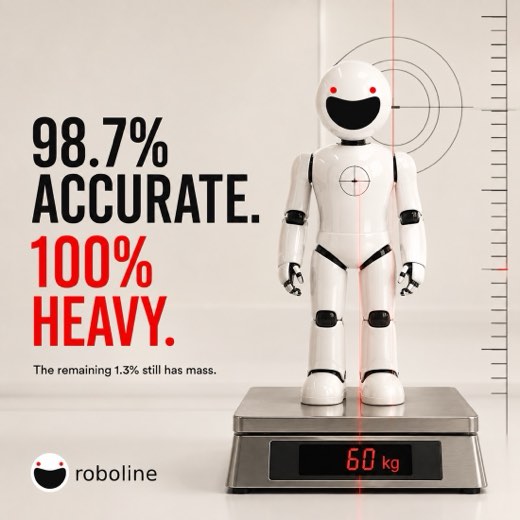
98.7% accurate. 100% heavy.
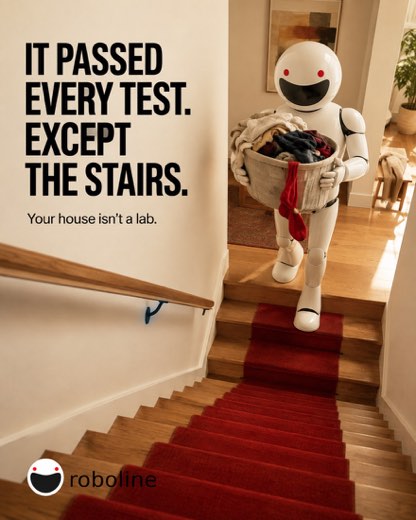
It passed every test. Except the stairs.
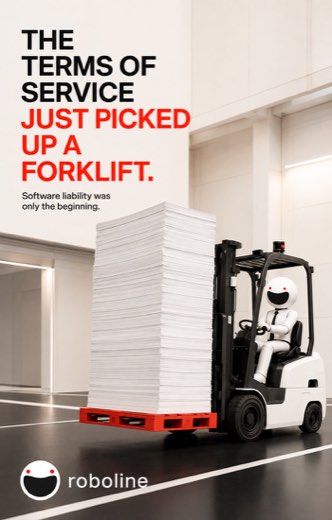
The terms of service just picked up a forklift
Artificial intelligence. Very real invoices.
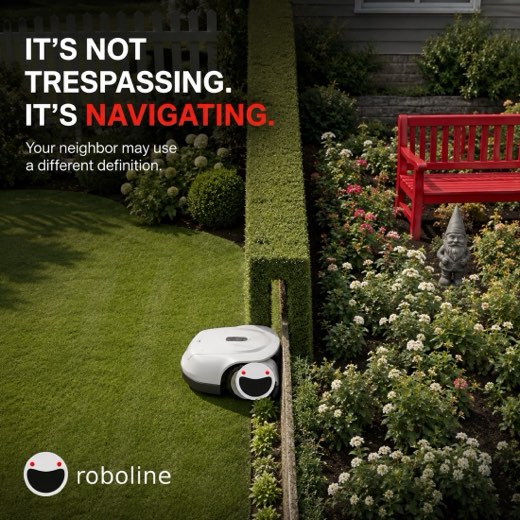
It's not trespassing. It's navigating.
ミスに、質量がある。
ミスに、質量がある。
バグに、体がついた。
バグに、体がついた。
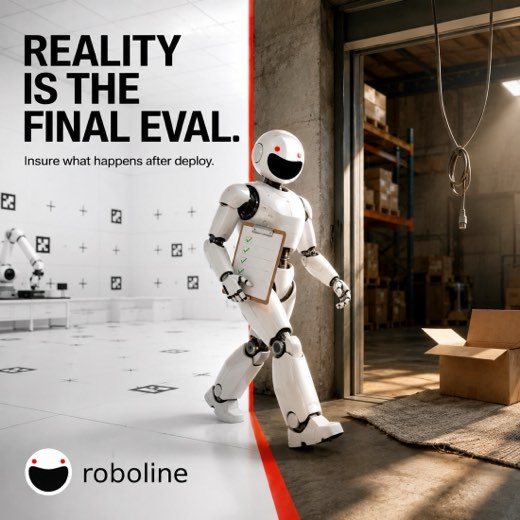
Reality is the final eval
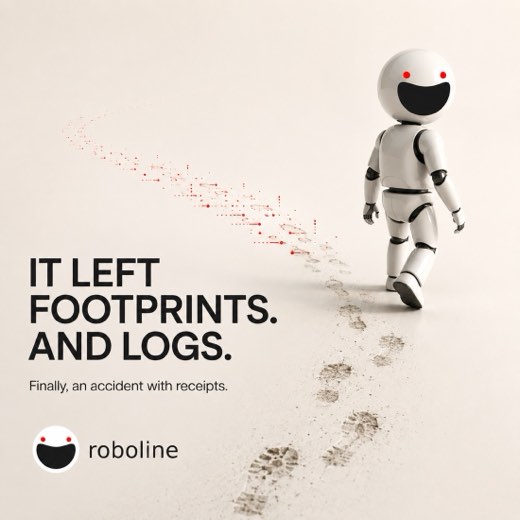
It left footprints. And logs.
No strings attached. Plenty of liability.
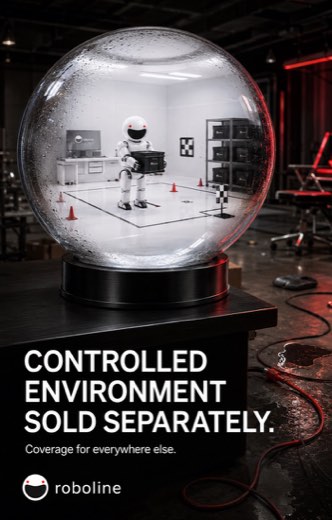
Controlled environment sold separately.
Congratulations. It's a liability.
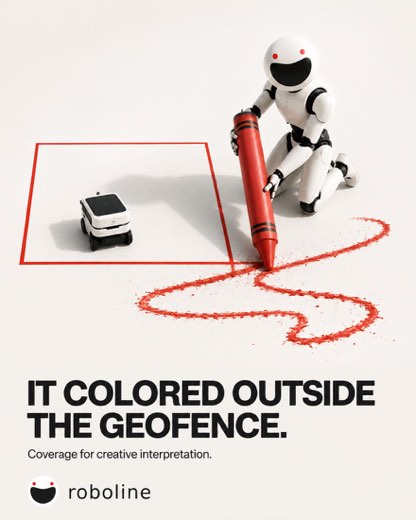
It coloured outside the geofence.
Your honor, it was an edge case.
Table manners were not in the training data.
You can't put autonomy back in the box.
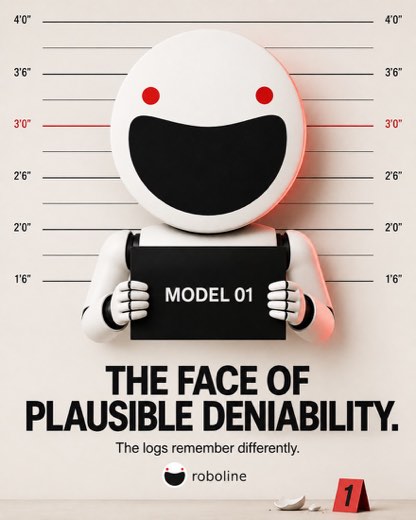
The face of plausible deniability.
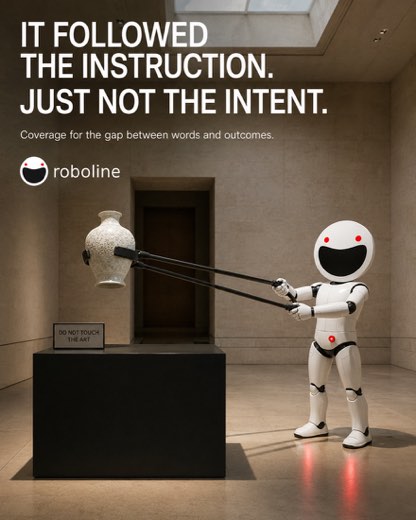
It followed the instruction. Just not the intent.
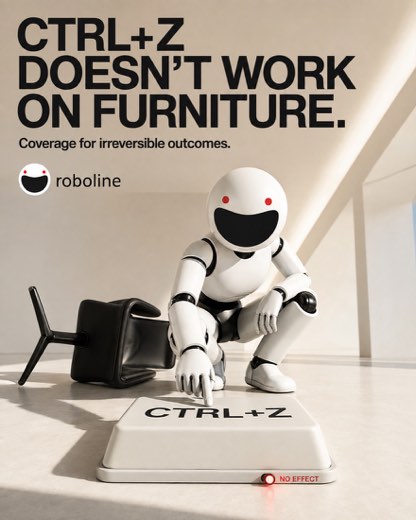
Ctrl+Z doesn't work on furniture.
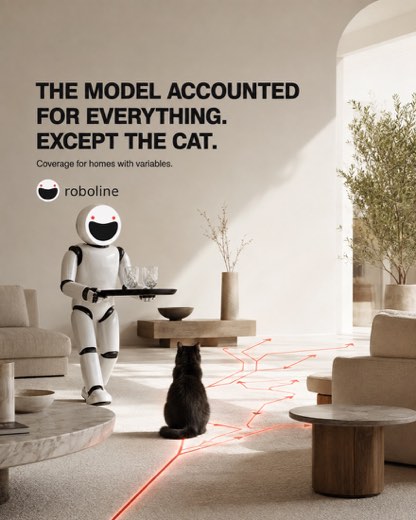
The model accounted for everything. Except the cat.

Three campaigns run off one face: Every body needs cover for robotics, We'll take the fall for industrial and OEM, and The robot did it for households — with Japanese executions written natively rather than translated.

Forward-looking statements. Unit counts, per-unit spend, and market totals on this page are Roboline's own bottom-up projections, presented with the model visible so that the assumptions can be argued with rather than taken on trust. They are not forecasts, guidance, or a representation that any figure will be achieved. Comparison figures for existing insurance lines are approximate industry orders of magnitude used for scale, not audited market statistics. Nothing here is an offer of insurance or of securities. Roboline products described as in design or in pilot are not generally available.